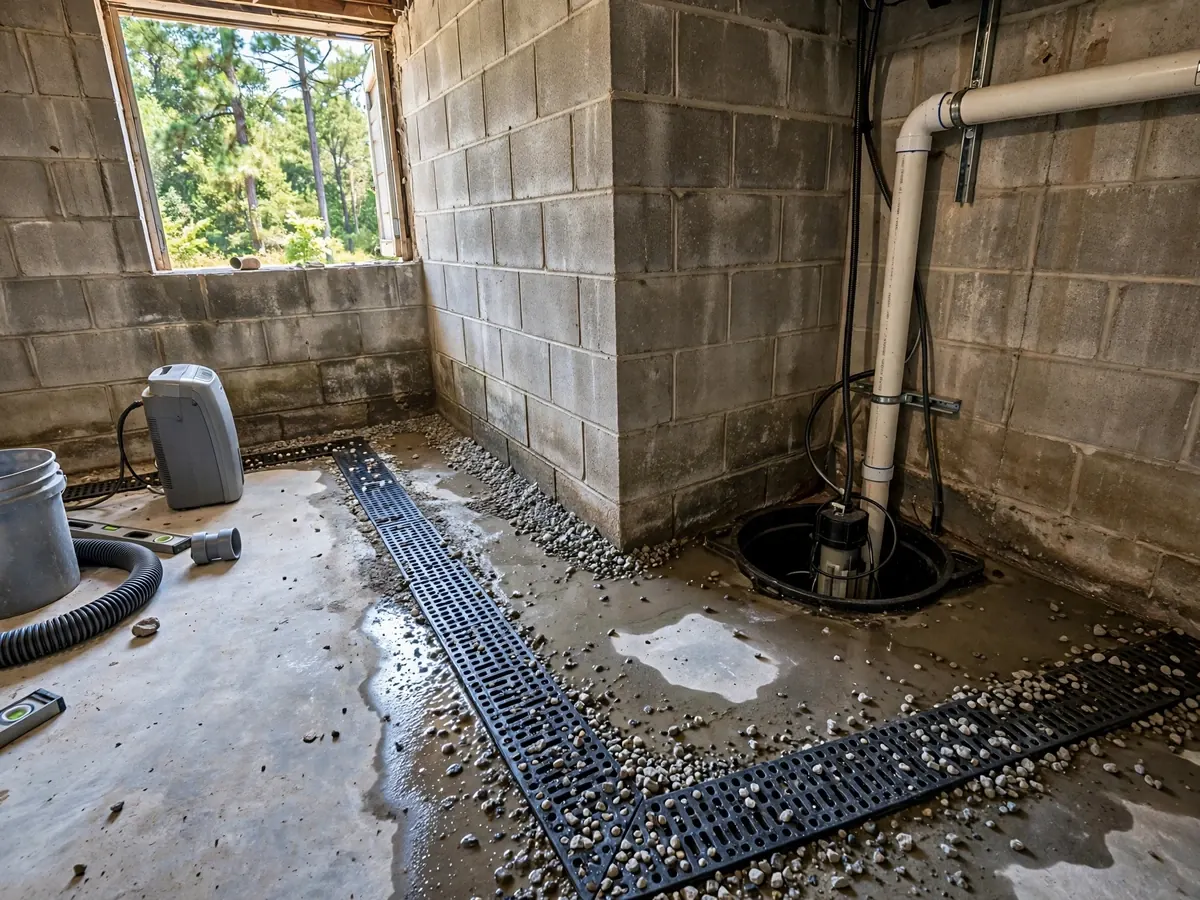
Find out where the water comes from
Start with a simple test. Tape a square of plastic sheet, about a foot across, tightly to the dry floor and leave it for a day or two. If water droplets form on the underside of the plastic, moisture is rising through the slab. If they form on top, the cause is humid air condensing on a cool surface.
Then look at the pattern. Water at the same spot after every rain points to a gutter, a downspout or the grade outside. Water along the wall and floor joint suggests groundwater pressure. Water at any time of year, with no link to the weather, points to a leaking pipe, and leak detection is the first step.
Waterproofing methods and what each one handles
Each method solves a different problem.
| Method | What it does | Works best for | Limit |
|---|---|---|---|
| Fix gutters and grade | Moves rainwater away from the foundation | Runoff seepage | Does not stop a high water table |
| Dehumidifier | Removes moisture from the air | Condensation and damp air | Will not stop liquid water |
| Interior perimeter drain with sump | Collects water at the wall and floor joint and pumps it out | Groundwater seepage | Needs a working pump and power |
| Crack injection | Seals a single foundation crack | One leaking crack | A new crack may open elsewhere |
| Floor and wall sealer | Reduces dampness in the surface | Minor dampness | Cannot hold back water under pressure |
| Exterior drainage and membrane | Waterproofs the outside of the wall | Severe or recurring problems | Highest cost, requires excavation |
A basement fix starts with the source. Call and we will help sort a leak from groundwater.
Call (860) 397-8103Why paint and sealers fail on a wet floor
A coating can only hold back water that is not pushing. When groundwater presses against a slab or a wall, it lifts the coating off the surface or finds the pores in the concrete and passes through. The paint blisters and peels, and the problem returns in the next wet season.
A coating is a finish, and it is worth using on a dry floor that only needs protection from dust and light dampness. For a floor with active water, a drain that gives the water a path is the answer, and the coating is optional afterward.
Interior drains and the sump pit
An interior drain system cuts a channel into the slab along the wall, lays a perforated pipe in gravel and slopes it to a sump pit. Water that comes through the wall or the floor joint falls into the pipe and runs to the pit, where a pump lifts it out of the house. The channel is then patched with concrete.
The system is only as good as the pump and the discharge. A pump that fails in a storm lets the pit overflow, and a discharge that dumps water near the foundation sends it right back. See sump pump repair and installation for how we size and set a pump.
Cheap steps to try first
Many wet floors improve with outdoor fixes.
- <strong>Extend downspouts.</strong> Discharge several feet from the foundation, onto ground that slopes away.
- <strong>Clean gutters.</strong> Overflow soaks the wall below.
- <strong>Regrade low spots.</strong> Soil next to the house should slope away from it.
- <strong>Check window wells.</strong> They need drainage and a cover.
- <strong>Run a dehumidifier.</strong> It helps with humid air, not with groundwater.
What a finished basement changes
If you plan to finish the basement, solve the water first. Carpet, drywall and framing over a wet floor grow mold and rot. Install the drain and pump before any finish, use a vapor-resistant subfloor and keep wood off the concrete.
A floor drain in a basement bathroom or laundry also needs care. It connects to the sewer, not to the sump, and a trap that dries out lets sewer gas rise. Keep the trap filled, and see plumbing installation if you are adding fixtures below the main drain.
A realistic way to budget the work
Waterproofing costs vary widely with the length of wall treated, the source of the water and whether concrete must be cut. Gutters and grading cost little. An interior drain with a pump costs more, and an exterior membrane costs the most. Ask for a written scope and a clear price for each option.
Do not let anyone sell you an expensive system before the source is known. A good contractor looks at the outside of the house, checks the plumbing and explains why a chosen fix fits the cause.
Radon and a sealed basement
If you seal cracks and add a sealed sump lid, you also change how air moves through the basement. Radon is a soil gas that can enter through slab cracks and sump pits. Testing is inexpensive, and a sealed lid is one reason to add it to the list. Ask a qualified radon professional if you want to test before or after the work.
Humidity, condensation and the floor that only looks wet
In summer, warm humid air meets a cool concrete floor and water condenses on the surface. The floor looks wet, but no water is coming through it. A dehumidifier set to a steady humidity, good air circulation and insulation on cold water pipes cut the problem. A floor that dries in a dry week is condensing, not leaking.
Keep stored boxes and furniture off the floor on shelves or pallets, so damp does not wick into cardboard. If you see a white powder on the concrete, called efflorescence, that is mineral salt left behind by moving moisture, and it tells you water has been passing through.
Code and moisture standards
Drainage that connects to plumbing follows the 2021 International Plumbing Code (IPC), which the 2022 Connecticut State Building Code adopts. Whether a permit is needed depends on the job and the town, and the Enfield building department can confirm it. Exterior digging requires a call to 811 first.
Groundwater and Enfield basements
Enfield lies in the Connecticut River valley, with the Connecticut River on its west boundary and the Scantic River and Scantic River State Park to the south. Basements near these water courses and brooks see more groundwater after heavy rain. The Town of Enfield can tell you whether your property sits in a mapped flood area, and the building office can say what permits an interior drain or a sump discharge needs.
Digging along the foundation requires notice to Call Before You Dig at 811 at least two full business days ahead. We look at basements in Enfield and in nearby East Windsor and Windsor Locks, where the river also drives the water table.
Basement floor waterproofing questions
Not if the water is under pressure. A sealer works for light dampness. Active water needs a drain.
No. Dampness can be condensation, and a leak is liquid water from a pipe or the ground. A plastic sheet test helps tell them apart.
Usually, if you collect water inside the house. The pump moves the water out.
You can handle the outdoor fixes and a dehumidifier. A drain and pump system involves breaking the slab and electrical work, and a contractor should do it.
Basements near the river and its brooks can see more groundwater after heavy rain. The Town can tell you about mapped flood areas for your address.