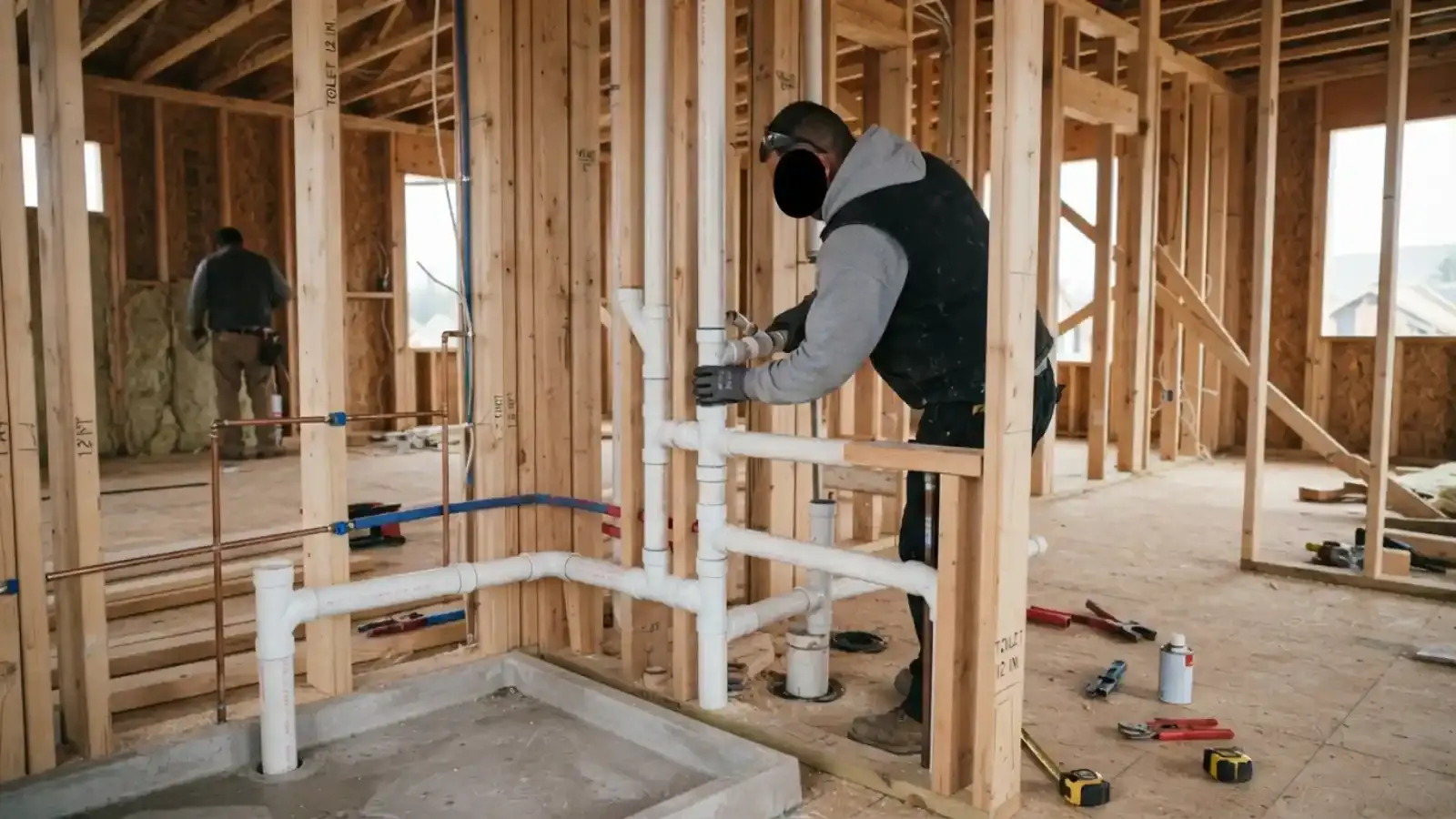
What counts as plumbing installation
Installation work adds or relocates fixtures and the pipes that serve them. That includes new sinks, toilets, tubs and showers, a dishwasher or washing machine hookup, an icemaker line, a utility sink in the basement and an outdoor hose bib. It also covers connecting a new appliance or water treatment unit to the existing system.
Most jobs involve three things: supply pipes, drain and vent pipes and a permit where one is required. The drain and vent side is the one people forget, and it is what limits where a fixture can go.
Questions to settle before the work starts
These decide whether a project is simple or complicated.
- <strong>Where is the drain?</strong> New fixtures need a drain with the right slope, and gravity decides what is possible.
- <strong>Is there a vent?</strong> A fixture without proper venting drains slowly and smells.
- <strong>Is there room in the wall or floor?</strong> Pipes need space, and joists limit the route.
- <strong>Does the system have capacity?</strong> A new bathroom adds load to the water heater and the main.
- <strong>Is a permit needed?</strong> We confirm with the Enfield building office.
Good installation work starts with a site visit. Call and we will book one.
Call (860) 397-8103Basements, additions and the drain problem
A basement bathroom is the common challenge, because the fixtures sit below the main drain. The solution is often an ejector pit with a pump that lifts waste up to the drain. That adds a pump and a pit, and sump and ejector pumps are a service we also provide.
In an addition, the new drain may tie into the existing line, so we check the line size and its condition. A camera inspection first avoids connecting a new bathroom to a drain that is already struggling.
Typical installation projects
Scope and complications differ by project.
| Project | Main work | Common complication |
|---|---|---|
| New bathroom | Supply, drain, vent, fixtures | Drain slope and vent route |
| Kitchen sink relocation | Move supply and drain | Vent and cabinet layout |
| Washing machine hookup | Supply valves and standpipe drain | Drain capacity |
| Basement bath | Ejector pit and pump | Concrete cutting, power supply |
| Outdoor hose bib | Frost-resistant spigot and supply | Wall penetration and freeze protection |
What we ask you to decide before the work
Installation goes smoothly when the choices are made early. Fixtures should be chosen and on site, or at least specified, before we rough in, because the rough-in dimensions depend on them. A toilet needs its distance from the wall, a vanity needs its supply height and a shower valve needs the depth of the wall.
We also ask who is handling the finishing trades. Tile, drywall and paint come after plumbing, and the schedule works best when the plumber, the tile setter and the painter know each other's dates. If you are working with a general contractor, we coordinate directly with them.
What affects the price of plumbing installation
Installation is quoted by scope after a visit.
Code basis for new plumbing
New plumbing runs, fixtures and rough-ins follow the 2021 International Plumbing Code (IPC), which the 2022 Connecticut State Building Code adopts. Whether a permit is needed depends on the job and the town, and the Enfield building department can confirm it. The Connecticut Department of Consumer Protection licenses plumbers, so you can ask any plumber about their license before work starts.
Installation work in Enfield homes
Enfield houses range widely in age, and so do their drains. An older house in Thompsonville or Enfield Village may have a drain line that needs a look before a new fixture connects to it. Access differs by house, and an unfinished basement makes a new connection easier.
We confirm what permits Enfield requires before work begins, and we do the same for projects in Ellington and Suffield, where the town office and rules differ.
Plumbing installation questions
Often yes for new fixtures and drain work. We confirm what applies and handle it as part of the job.
Yes. We check the fixture and the connections first so the install goes smoothly.
Use the state's elicense lookup at elicense.ct.gov and search by name or license number.
Usually, with an ejector pump if the fixtures sit below the main drain. We check the drain before we quote.
It depends on the scope. We give a schedule after the site visit.