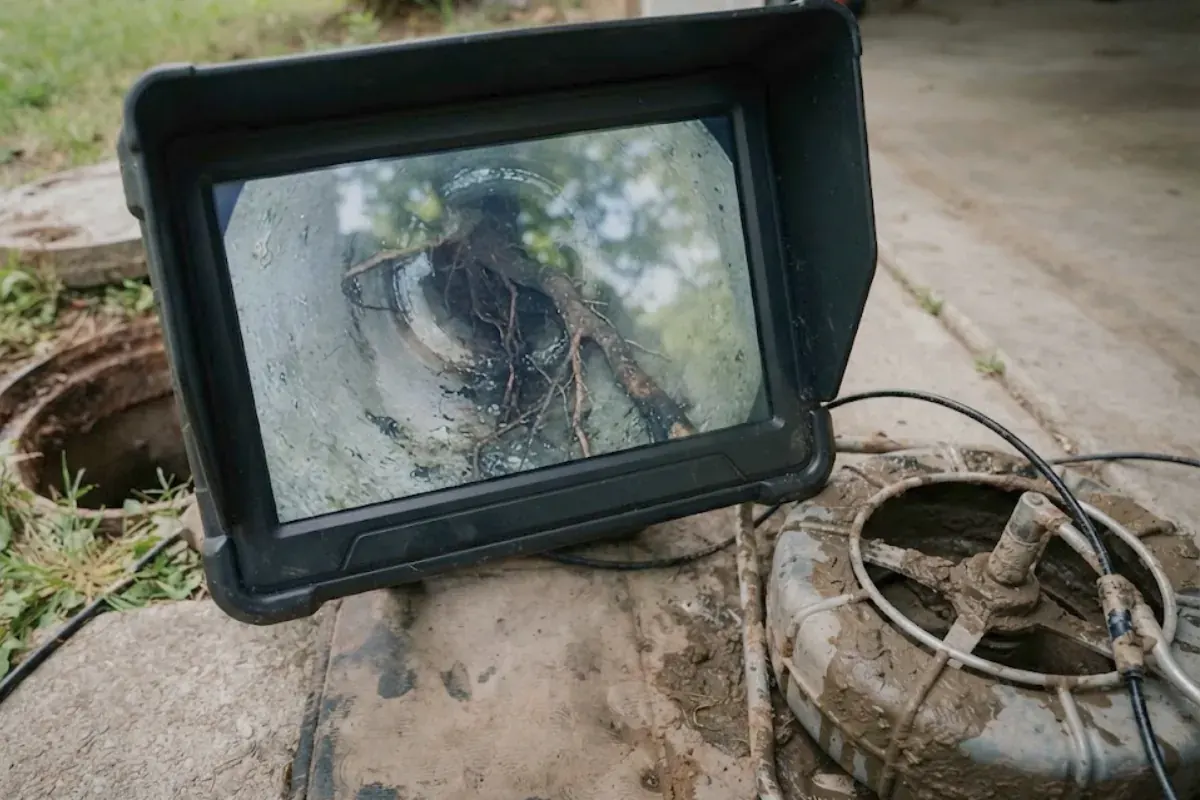
What a sewer camera inspection shows
The camera head is about the size of a small flashlight and carries its own lights. It is pushed through a cleanout toward the street while a monitor shows the pipe wall. We note the material, any offset joints, low spots where water pools, cracks, and where roots enter, then record the footage.
A locator on the camera lets us mark the surface directly above any defect, which turns a vague finding into a measured one. That is what lets a repair estimate be accurate instead of padded for uncertainty.
Good reasons to schedule an inspection
Most inspections fall into one of these situations.
- <strong>Buying a house.</strong> A lateral that looks fine from the basement may be rooted or bellied near the street.
- <strong>Repeat clogs.</strong> The same drain backing up within weeks usually points to pipe condition.
- <strong>After a repair.</strong> Footage confirms that a spot repair or lining sits where it should.
- <strong>Before landscaping.</strong> New trees and driveways are safer once you know where the line runs.
- <strong>Older neighborhoods.</strong> Houses in Thompsonville and Hazardville can have laterals of different ages, so we confirm the line before quoting a repair.
Booking an inspection before closing is cheaper than finding a collapsed lateral after it.
Call (860) 397-8103What the camera can and cannot tell you
An inspection is powerful and still has limits worth knowing.
| Question | The camera can answer | Limit |
|---|---|---|
| What is the pipe made of? | Yes, from joints and wall texture | Mixed materials need closer review |
| Is there a crack or offset? | Yes, with a depth mark from the locator | A very dirty line may need cleaning first |
| Are roots present? | Yes, with location and density | It cannot say how fast they regrow |
| Is there a sag? | Often, where water pools | A small belly may need a second pass |
| Is the street main sound? | Only the part we can reach | The public main is the town's responsibility |
Before, during and after the visit
Before the visit, tell us where the cleanout is, or let us find it. If there is none, we can usually enter through a toilet flange or a roof vent, though a cleanout installed first makes every later service easier. During the visit, you can watch the monitor and ask us to stop on anything that looks odd.
Afterward you get the findings in plain language and a recommendation. If the line is sound, we say so and leave it alone. If it is not, the next step is usually sewer line cleaning or sewer line repair, and you choose with the footage in hand.
What affects the price of a sewer camera inspection
Planned inspections are priced by scope and stated before the visit.
What a camera inspection does and does not cover
A camera inspection records pipe condition but does not replace a code inspection. Any repair it leads to follows the 2021 International Plumbing Code (IPC), which the 2022 Connecticut State Building Code adopts. The Connecticut Department of Consumer Protection licenses plumbers, so you can ask any plumber about their license before work starts.
Inspecting laterals across Enfield and nearby towns
Enfield is a large town with distinct sections: Enfield Village, Thompsonville, Hazardville, Scitico and Sherwood Village. Lateral age and material can differ across them, so we avoid assuming that one street's pipe matches the next.
If you are buying in the area, inspections are just as useful across the border in Ellington, where suburban growth added a lot of newer lines, and in Suffield, where many lots are older.
Sewer inspection FAQ
A planned inspection is a scheduled service, usually the same week. If a backup is happening now, we dispatch it as an emergency and use the camera as part of the repair.
Most take under an hour when access is good. A line that needs cleaning first takes longer.
Yes. You can keep the footage and share it with a buyer, a seller or your insurer.
Someone should be present to give access and see the findings. A landlord can authorize access to a tenant's unit.
Yes. It is the only way to see a root intrusion or sag before it becomes a backup.