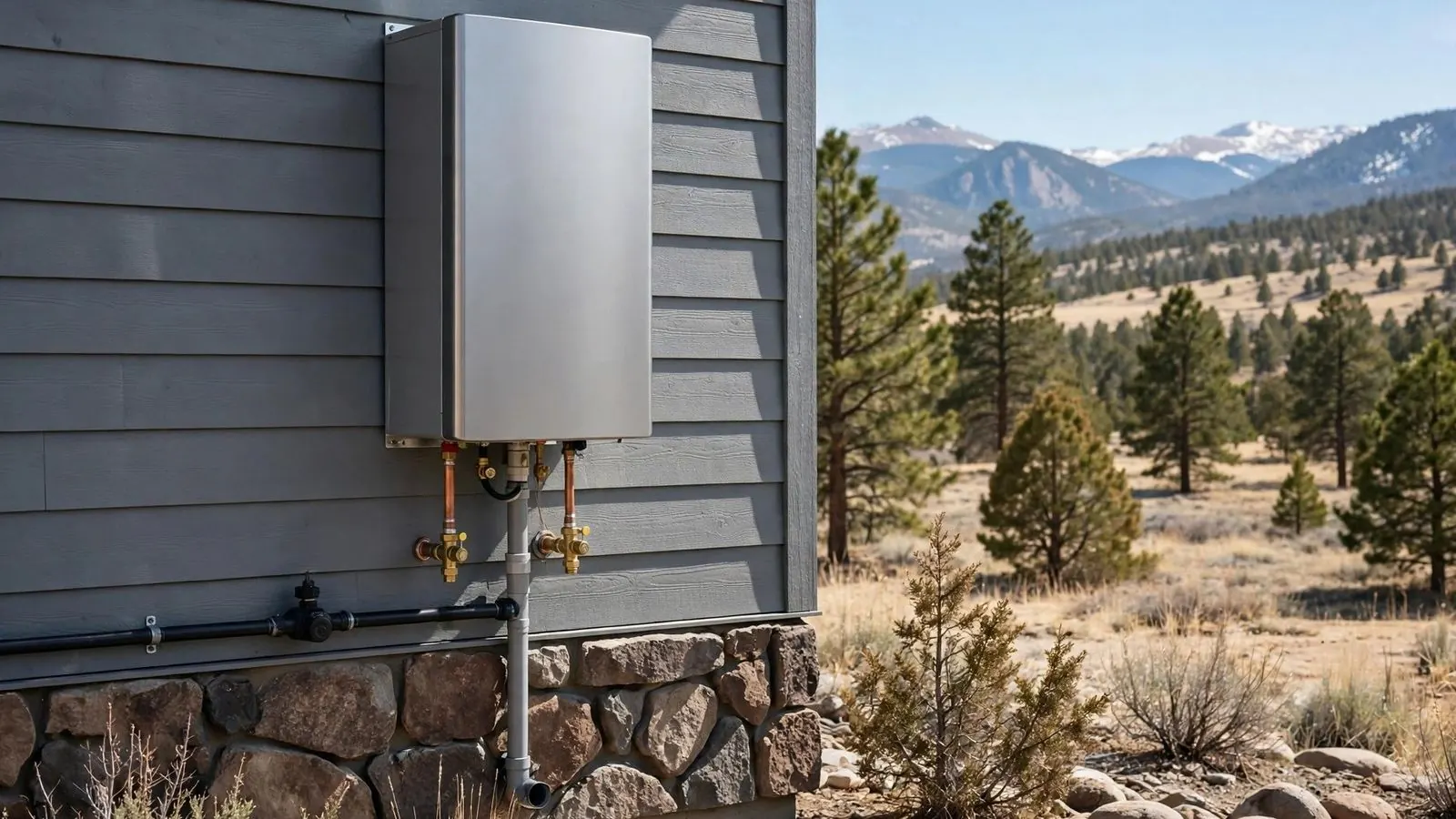
What an outdoor tankless unit is
Indoor tankless units need a vent pipe through a wall or roof. An outdoor model is built into a weatherproof cabinet, so it vents into open air directly and needs no vent pipe. The unit fires on demand, as any tankless heater does, and the cabinet protects the burner and controls from rain and snow.
Because the unit sits outside, it frees floor space inside and keeps combustion away from the living area. It also puts water lines and a heat exchanger where winter can reach them, and that is the issue that decides the choice in Connecticut.
Freeze protection: the question that matters most
Outdoor tankless heaters include freeze protection, usually a heating element or a program that runs the burner to keep the unit above freezing. It works as long as the unit has power and fuel. In a long outage during a deep cold snap, protection can fail, and the water inside can freeze and crack the heat exchanger.
The pipes that connect the unit to the house are the other exposure. Short, insulated runs on an exterior wall are safer than long exposed ones. We check the manufacturer's freeze rating and the lowest design temperature, and we tell you what happens if the power goes out.
An outdoor unit is not right for every house. Call and we will tell you honestly whether yours is a good candidate.
Call (860) 397-8103Indoor or outdoor: how they compare
Both can be the right choice. The house decides.
| Factor | Indoor tankless | Outdoor tankless |
|---|---|---|
| Venting | Needs a vent pipe through wall or roof | No vent pipe, exhausts in the open |
| Floor space inside | Takes wall space in a closet or basement | None |
| Freeze risk | Low in a heated space | Needs freeze protection and power |
| Service access | Indoors, any weather | Outside, in winter weather |
| Appearance | Hidden | Visible on the exterior wall |
| Best for | Most Connecticut houses | Houses with no room or no vent route |
What to confirm before you choose
These settle most outdoor installs.
- <strong>Gas line size.</strong> A tankless unit needs a lot of fuel at once, and the line may need to be larger.
- <strong>Wall location.</strong> The unit needs clearances from windows, doors and the meter.
- <strong>Power.</strong> Freeze protection and controls need an outlet that stays on.
- <strong>Pipe insulation.</strong> Exposed runs need insulation and, in some cases, heat trace.
- <strong>Maintenance.</strong> Flushing and inspection happen outdoors, so plan for access in cold months.
Maintenance and winter problems
An outdoor unit needs the same maintenance as an indoor one. A yearly flush with descaling solution clears mineral buildup, and the inlet screen and the condensate drain, on a condensing model, need checking. The difference is that all of it happens outside, and a clogged condensate drain can freeze and cause a shutdown.
If you see an error code in a deep freeze, check that the unit has power and fuel, and that snow has not blocked the cabinet openings. Persistent codes are a reason to call, and tankless repair and flushing is a service we provide.
A reasonable way to decide
If your house has a basement with room and a vent route, an indoor tankless unit or a standard tank is usually the safer choice in this climate. If the basement is cramped, the vent route is hard or you are adding an addition with no mechanical room, an outdoor unit is worth pricing.
Compare the full scope, including a gas line upgrade, freeze protection and pipe insulation, not just the price of the unit. For a straight swap in an existing house, our water heater installation page covers the planned options.
Questions to ask any installer
Ask the installer which freeze rating the unit carries and what lowest outdoor temperature it was designed for. Ask what happens during a power outage, how the pipes will be insulated and who services the unit if a code appears in January. A clear answer to each is a good sign.
Ask also for the full scope in writing, including the gas line, the vent or termination, the condensate drain on a condensing model, any permit fees and the removal of the old tank. Comparing quotes by scope is the only fair way to compare them.
Gas supply and the size of the line
A tankless unit can burn a large amount of gas in a short time, and the gas line has to deliver it. A line that served a tank heater may be too small, and a meter may be sized for a smaller load. The plumber measures the length of the run, counts the other gas appliances in the house and checks the line against the unit's rating.
If the line needs upgrading, that is part of the cost. Ask for it as a separate line item so you can compare quotes fairly, and ask your gas utility whether the meter needs attention.
Wall placement, clearances and appearance
An outdoor unit hangs on an exterior wall, and its position matters. It needs clearance from windows, doors, vents and the gas meter, and room to open the service panel. Snow load and drifting matter too. A unit under an eave that sheds a sheet of snow can be damaged.
Think about the look as well. Some owners are fine with a visible unit on a side or rear wall, and others prefer a hidden installation. A neighbor's view and your own patio are worth considering before the hole is cut in the wall.
Code and climate considerations
Outdoor tankless units must meet the manufacturer's listing for outdoor use and the 2021 International Plumbing Code (IPC), which the 2022 Connecticut State Building Code adopts for the water connections. In Connecticut, freeze protection is the main concern. Whether a permit is needed depends on the job and the town, and the Enfield building department can confirm it.
Outdoor units and Enfield winters
Enfield is in the Connecticut River valley, and winters here bring hard freezes. Ask the Enfield building office what permits and clearances apply to an outdoor unit on your house. The 2022 Connecticut State Building Code adopts the 2021 International Plumbing Code, and the town can tell you which local rules sit on top.
Your water comes from either Connecticut Water or Hazardville Water, and your supplier's water quality report tells you about mineral content that affects flushing. We install and service units in Enfield and in nearby Suffield and East Windsor.
Outdoor tankless questions
Yes, if it is an outdoor-rated model with freeze protection. The risk is a long power outage in a deep freeze, so we discuss it before you choose.
Freeze protection stops working, and the unit can freeze if the outage is long and cold. A backup power plan is worth considering.
No. It exhausts directly to outside air, and the cabinet protects the burner.
A plumber can flush and inspect it, and we schedule around the weather. See our tankless page for details.
Sometimes. A house with no good vent route or no space inside can benefit, and one with a basement room usually does better indoors.