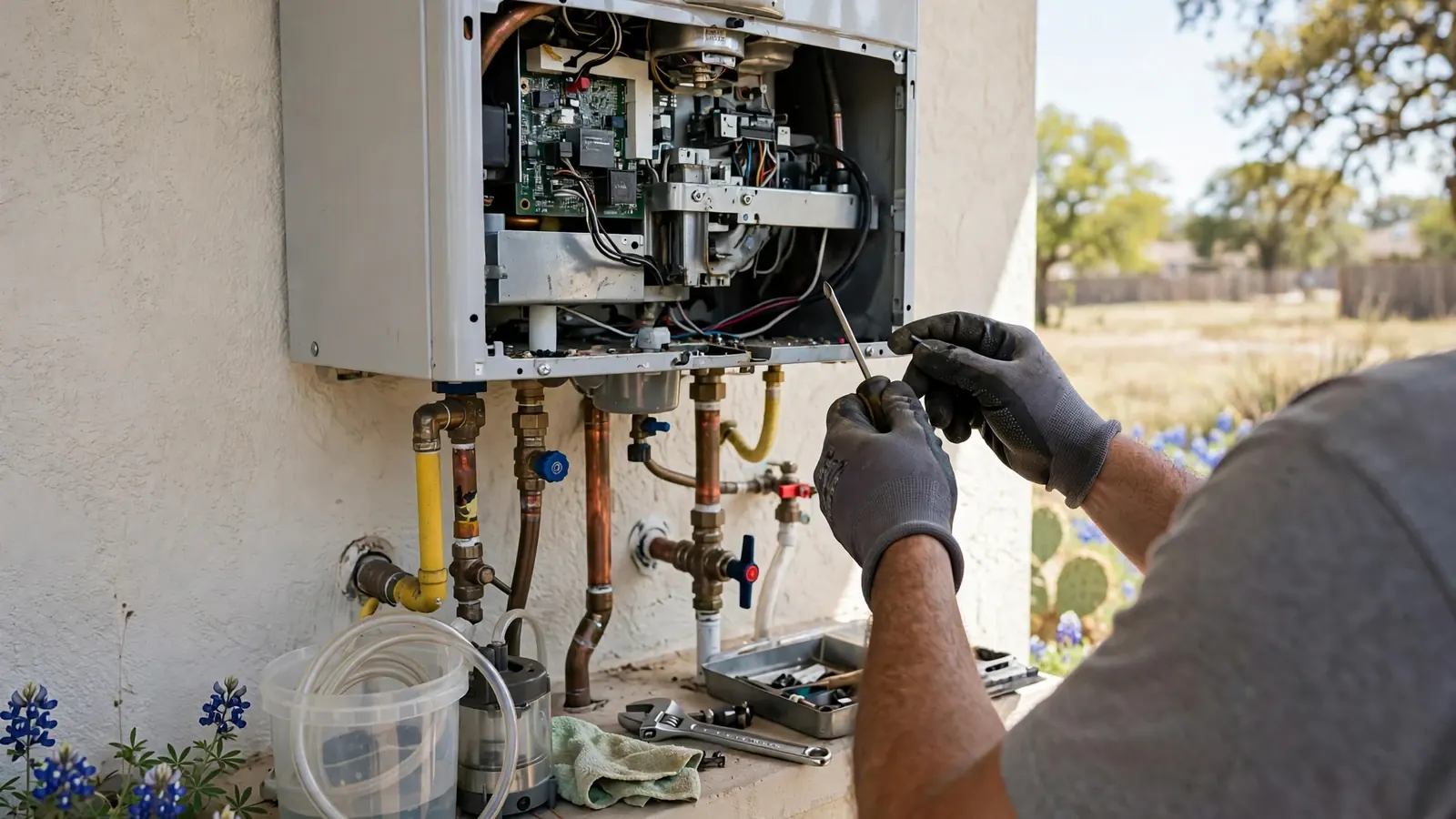
How a tankless unit differs from a tank
A tank heater stores a set volume and reheats it as it cools. A tankless unit fires a burner or powers elements only when water flows, so it never runs out while it is working, but it has a maximum flow rate. Run a shower, a dishwasher and a laundry load together and a small unit may fall short.
Because tankless units need a lot of fuel or power in a short burst, a gas unit often needs a larger gas line and a new vent. An electric tankless unit can need a heavy circuit that the panel does not have to spare.
Is tankless a fit for your house
Answer these before you decide.
- <strong>Gas supply.</strong> Is the gas line large enough, and is the meter sized for the added load?
- <strong>Venting.</strong> Is there a route for new vent pipe to the outside?
- <strong>Electrical capacity.</strong> For electric models, does the panel have room for the circuit?
- <strong>Water quality.</strong> Sediment and scale build up in the heat exchanger, so ask your water supplier about its report.
- <strong>Demand.</strong> How many fixtures run at the same time in your home?
A tankless unit is a good fit for some houses and a poor one for others. Call and we will tell you which yours is.
Call (860) 397-8103Flushing and descaling: the maintenance that matters
Minerals in the water coat the heat exchanger inside a tankless unit. The coating cuts efficiency, causes error codes and shortens the unit's life. A flush with a descaling solution cleans it out. The right interval depends on your water, so we do not promise a number. Ask your supplier for its water quality report and we will set a schedule from the unit's manual.
Flushing also lets us check the inlet filter, the condensate drain on a condensing model and the burner or elements. Skipping it is how a good unit ends up as a repair call.
Common tankless problems and fixes
Most faults fall into a short list.
| Problem | Likely cause | Typical fix |
|---|---|---|
| Lukewarm water | Scale on the heat exchanger or low flow | Descale, clean the inlet screen |
| Error code on the display | Ignition, venting or flow fault | Read the code, correct the cause |
| Cold sandwich effect | Hot water pausing between uses | Check settings, consider a recirculation loop |
| Unit will not fire | Gas supply, flame sensor or low flow | Test gas pressure, clean the sensor |
| Condensate leak | Blocked drain on a condensing unit | Clear the drain and neutralizer |
What affects the price of tankless work
Tankless jobs vary more than tank swaps.
Code, venting and gas supply
A tankless install follows the 2021 International Plumbing Code (IPC), which the 2022 Connecticut State Building Code adopts for the water side, and gas sizing and venting follow the manufacturer instructions and local code. Whether a permit is needed depends on the job and the town, and the Enfield building department can confirm it.
Tankless in Enfield's houses and apartments
Enfield homes differ in gas service and capacity. In an older home, including those in Thompsonville and Enfield Village, the gas line and chimney need checking before a tankless unit makes sense.
Whether the water you draw comes from Connecticut Water or Hazardville Water, ask for the supplier's water quality report and a hardness figure before choosing a flush interval. We also work in Somers and Windsor Locks.
Tankless water heater questions
It can be if you value space, steady supply and efficiency, and your house can handle the fuel and vent needs. For some homes, a standard tank costs less overall.
It depends on your water. We follow the manufacturer's guidance and your supplier's water quality report to set a schedule.
Yes. Codes point to ignition, venting, flow or sensor faults, and we diagnose and correct the cause.
Yes. Most use sealed plastic or stainless vent pipe, and the route depends on the model and the house.
A tankless unit that is leaking is an emergency and our line answers 24/7. See water heater repair.