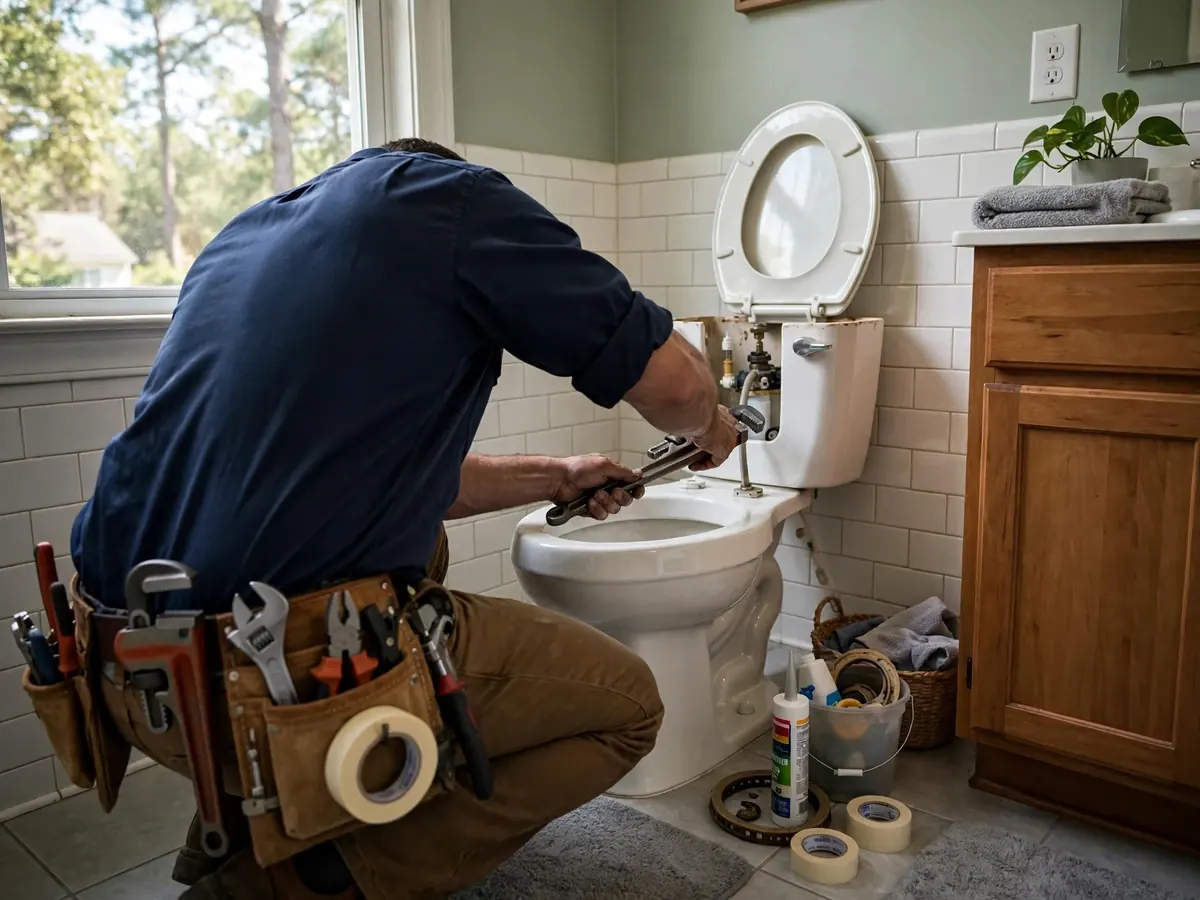
Overflowing toilet: stop the water first
A toilet that is running over puts wastewater on your floor and down through the ceiling below. The fastest fix is cutting the supply, because the tank keeps refilling the bowl.
Follow these steps and then call.
- Turn the shutoff valve behind the toilet clockwise until it stops.
- Lift the tank lid and press the flapper down if the water is still rising.
- Keep children and pets out of the bathroom and wash hands after cleanup.
- If other drains gurgle or back up, stop using water in the house.
- Call (860) 397-8103 and say whether the problem is the toilet alone.
Common toilet problems and what they mean
A running toilet is usually a worn flapper, a fill valve that no longer shuts off or a chain that is too tight. A toilet that flushes weakly may have clogged rim jets or a partial blockage. A base that rocks or leaks at the floor often means the wax ring has failed or the flange is cracked or sitting too low.
A leak at the floor is worth acting on quickly because water seeps into the subfloor and rots it over time. When a toilet clogs repeatedly, the issue may be the drain behind it, and drain cleaning is the next step.
A toilet that overflows once may be a clog. One that overflows with other drains gurgling is a main-line problem.
Call (860) 397-8103Symptom, cause and fix
Most repairs are quick when the cause is clear.
| Symptom | Likely cause | Typical repair |
|---|---|---|
| Toilet runs constantly | Worn flapper or fill valve | Replace the part |
| Weak flush | Clogged rim jets or low tank water | Clean jets, adjust fill level |
| Water at the base | Failed wax ring or cracked flange | Reset toilet with a new ring or flange repair |
| Rocking toilet | Loose bolts or uneven floor | Reseat and shim |
| Repeated clogs | Drain restriction or old low-flow design | Snake the drain, consider replacement |
| Tank sweats or leaks | Condensation or worn tank bolts | Replace gaskets or bolts |
Installing a new toilet
Replacing a toilet is a small job with a few details that matter. The flange has to be sound, the new wax ring or sealing gasket seated and the water supply line in good condition. We measure the rough-in distance from the wall to the flange bolts so the new toilet fits, and we remove the old one for disposal.
If the floor around the old toilet is soft, we show you before we set the new one, because a toilet on a rotten subfloor will rock again.
What affects the price of a toilet repair or installation
Repairs are quoted by the part. Installs add the toilet itself.
Why code matters for a toilet
Toilets, wax seals and supply stops are covered by the 2021 International Plumbing Code (IPC), which the 2022 Connecticut State Building Code adopts, including fixture clearances. Simple internal repairs rarely need a permit, while moving or replacing the drain does. The Connecticut Department of Consumer Protection licenses plumbers, so you can ask any plumber about their license before work starts.
Toilets in older Enfield bathrooms
In any older house, including those in Thompsonville, Enfield Village and Hazardville, a bathroom may have been remodeled over time. A toilet set on a flange that was never raised to a new floor is a common source of leaks, and we check the height before we reset anything.
A toilet that is slow or clogs often because of the drain behind it is worth a camera look, and homeowners in Somers and Ellington book the same visit.
Toilet repair questions
Yes. An overflowing or leaking toilet is dispatched as an emergency 24/7. Close the valve behind the toilet and call, and we will talk you through the rest.
Most often the flapper no longer seals or the fill valve is not shutting off. Both are inexpensive parts.
Water at the floor around the base points to the wax ring or flange. A leak at the tank or the supply line is a different repair.
Yes. We check the rough-in size so the new toilet fits.
The toilet may be fine and the drain restricted. We snake the line and camera it if the clogs return.