Gas safety comes before any repair
A gas water heater is a combustion appliance, and a mistake can cause a fire, a gas leak or carbon monoxide. Never work on gas parts if you smell gas, and never relight a pilot in a room that has a gas odor.
If you smell gas at any point, follow these steps.
- Do not touch light switches, phones or anything that can spark.
- Leave the building at once and take everyone with you.
- Call your gas utility or 911 from outside.
- Do not go back in until the utility says it is safe.
- After the gas is cleared, call (860) 397-8103 for the repair.
What a thermocouple does
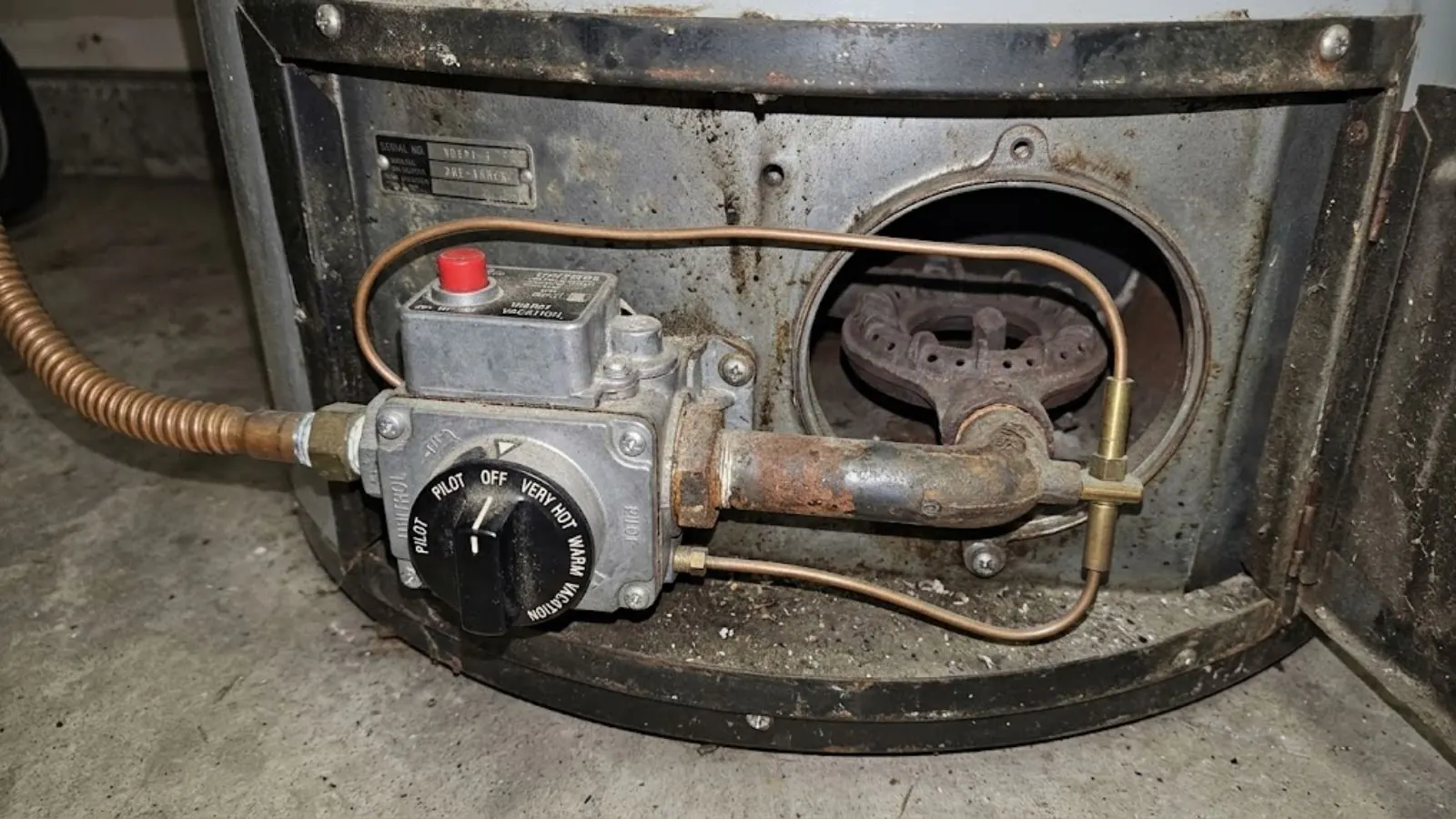
The thermocouple is a short metal probe whose tip sits in the pilot flame. Heat from the flame makes a tiny electric current, and that current holds the gas valve open. If the flame goes out, the current stops and the valve closes, so gas cannot flow to an unlit burner.
Because it is the heater's flame-failure safety, a thermocouple that is worn, dirty or out of position cannot be treated as a simple annoyance. A heater that keeps shutting off is telling you the safety is working or failing.
If you ever smell gas, leave the house and call your gas utility or 911 first. Then call us for the repair.
Call (860) 397-8103Why a pilot goes out and what it points to
Check these in order before you assume the thermocouple is the problem.
| Symptom | Likely cause | Next step |
|---|---|---|
| Pilot will not stay lit when you release the button | Worn or dirty thermocouple | Clean the tip or replace the part |
| Pilot lights but goes out hours later | Draft, dirty pilot orifice or weak flame | Clean and check the flame |
| Pilot lights and burner will not fire | Gas control valve problem | Plumber diagnosis |
| Pilot flame is yellow and flickers | Dirty pilot or poor air supply | Clean and check combustion air |
| Pilot goes out with a gas smell | Gas leak or venting problem | Leave the house and call the gas utility |
What replacement involves
To replace the part, the gas is turned off at the control, the old thermocouple is unscrewed from the gas valve and pulled from the pilot bracket, and the new one is fitted at the same length and position. The tip must sit in the pilot flame. The connection to the valve is hand tight plus a small turn with a wrench, because over-tightening damages the valve.
After the new part is in, the pilot is relit following the label on the heater, and the flame is checked. A good flame is steady and blue, and it wraps the thermocouple tip. We also look at the burner, the vent and the combustion air while the heater is open.
Homeowner job or plumber job
Be honest about which side of the line you are on.
- <strong>Relighting a pilot.</strong> Many homeowners can do this by following the label, if there is no gas smell.
- <strong>Cleaning the thermocouple tip.</strong> A light cleaning is simple when the heater is off.
- <strong>Replacing the thermocouple.</strong> Doable for a confident person, but gas connections need care.
- <strong>Gas valve, burner or venting work.</strong> Plumber job, because combustion safety depends on it.
- <strong>Any gas odor or soot.</strong> Stop and call the gas utility, then a plumber.
When replacing the heater makes more sense
A thermocouple costs little, and replacing it on a heater in good shape is sensible. If the tank is old, rusted or leaking, the part is not the only problem, and a new heater may cost less than repeated repairs. A plumber can check the age plate, the burner, the vent and the tank.
If the heater is at the end of its life, see water heater replacement to understand the options, and for planned work water heater installation.
Signs of poor combustion to take seriously
A healthy burner flame is mostly blue and steady. Yellow tips, soot on the heater or the vent, a burning smell or rust flakes at the burner are signs of poor combustion. They can come from a dirty burner, a blocked vent or too little air in the room.
Poor combustion can produce carbon monoxide, which has no smell. A working carbon monoxide alarm near the heater and the bedrooms is a cheap safeguard, and any alarm should be treated as a reason to leave the house and call for help.
How a gas water heater lights and stays lit
A standing pilot heater keeps a small flame burning all the time. The thermocouple senses that flame and holds the gas valve open. When the thermostat calls for heat, the valve opens the main burner, and the pilot lights it. If the pilot goes out, the thermocouple cools and the valve closes the gas.
Newer heaters often use electronic ignition and have no standing pilot, so the thermocouple does not apply to them. Knowing which kind you have saves time, and the label on the heater says which.
What a plumber checks while the heater is open
A failed thermocouple is often a sign of something else. We look at the pilot orifice for dirt, the burner for soot, the vent for draft and the combustion air supply for blockage. A poor draft can blow out a pilot, and a closed-in closet can starve it of air.
We also check the relief valve, the drain valve and the age of the tank. A heater that is well past a decade needs a frank conversation, because a repair on a failing tank may only delay a leak. A short visit gives you a full picture and a plan.
Gas safety first
A thermocouple is part of a gas safety circuit, so treat any gas work carefully. If you smell gas, leave the building and call your gas utility or 911. Gas appliance work follows local code and the 2021 International Plumbing Code (IPC), which the 2022 Connecticut State Building Code adopts for water connections. The Connecticut Department of Consumer Protection licenses plumbers, so you can ask any plumber about their license before work starts.
Gas, venting and local rules in Enfield
Your gas utility is the first call for any gas odor, and the Enfield building office can tell you what permits apply to heater work. The 2022 Connecticut State Building Code adopts the 2021 International Plumbing Code, and the town can say which local rules apply. Do not rely on a general guide for venting or permit questions.
To check that a plumber is licensed, the state's elicense lookup is at elicense.ct.gov. We repair heaters in Enfield and in nearby Windsor Locks and Suffield, and older basement heaters are a common call across Enfield.
Thermocouple questions
The pilot lights while you hold the button, then goes out when you let go. A new part usually cures it, if the flame is also healthy.
A light cleaning of the tip with fine abrasive can help. If the pilot still drops out, replace it.
No. A thermopile makes more power and is used on some systems. Match the part to your heater's model.
Leave the building and call your gas utility or 911 from outside before anything else.
Often it does, because other parts age too. We check the whole heater when we open it.