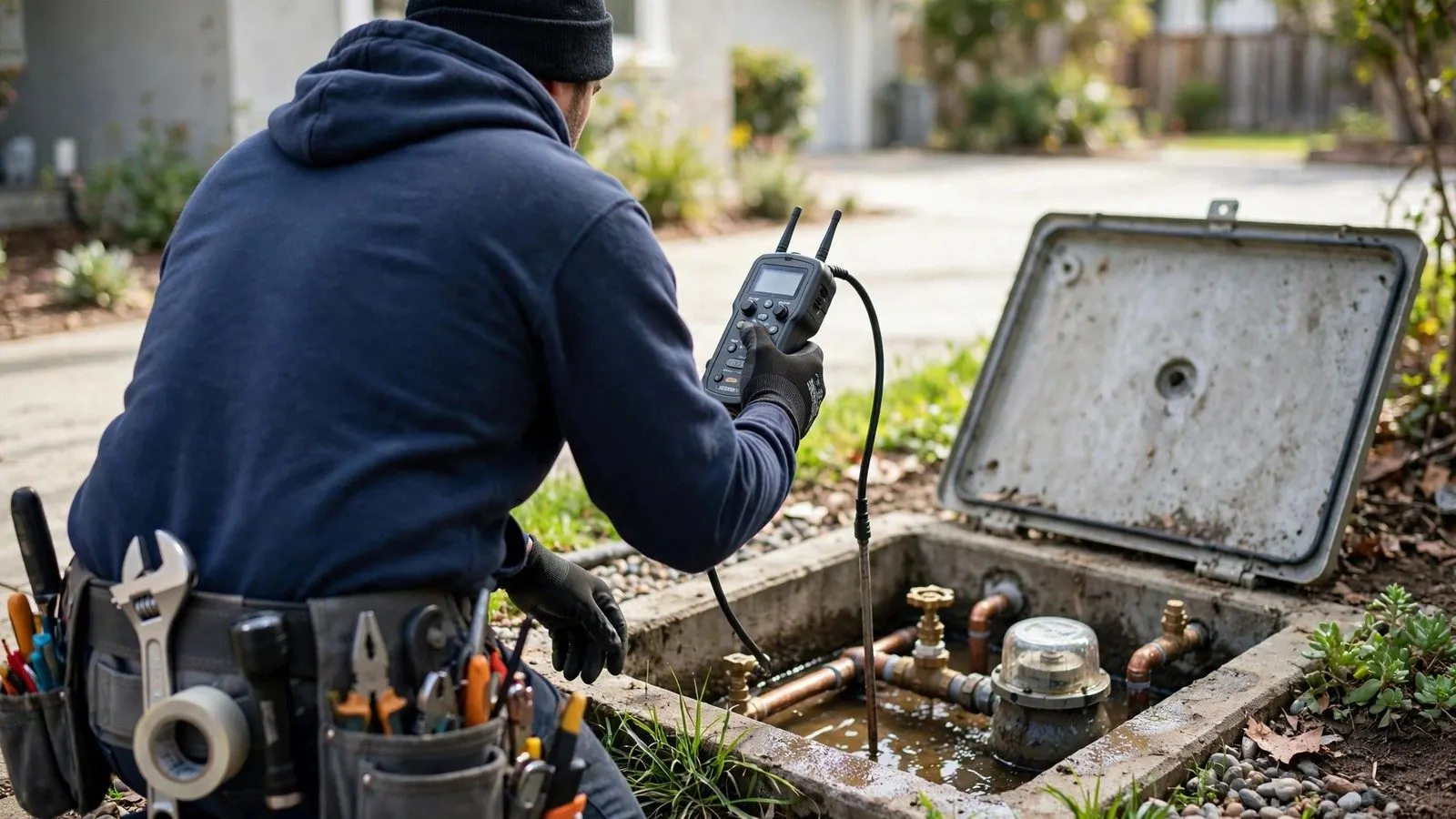
The meter test: is water leaking at all?
Turn everything off
Shut off all taps, the dishwasher and the washing machine. Make sure no toilet is running and that the ice maker is not filling.
Read the meter
Open the meter cover and look at the dial or the low-flow indicator. Many meters have a small triangle or wheel that spins when any water moves.
Note the number and wait
Write down the reading. Wait one to two hours with all water off.
Read again
If the number changed, or the indicator moved while nothing was on, water is leaking on the house side of the meter.
Close the main and repeat
Shut the main valve inside the house and check the meter. If it still moves, the leak is between the meter and your valve. If it stops, the leak is inside the house.
Clues in the yard and around the house
Look along the path of the line, from the street or the meter to the house. A strip of grass that is greener or taller than the lawn around it, a soft spot where the ground feels spongy, a sunken patch or a puddle that appears when the weather is dry can all mark a leak. In winter, a patch where snow melts first or a spot of ice on a warm day is another sign.
Inside the house, look near where the line enters. A damp basement wall, a musty smell or a pool on the floor at the entry point suggests the leak is close to the foundation. Pressure that has fallen across the house, and a bill that has climbed, add to the picture.
Checks you do yourself narrow the search. A plumber with listening equipment finishes it.
Call (860) 397-8103What the clue suggests
One clue is a hint. Several together are a pattern.
| Clue | What it suggests | Next step |
|---|---|---|
| Meter moves with everything off | A leak on the house side | Close the main and recheck |
| Meter stops when the main is closed | Leak inside the house | Check toilets, fixtures and walls |
| Meter still moves with the main closed | Leak between the meter and the house | Call for detection |
| Green or soggy strip in the yard | A buried line leak | Mark the spot and call |
| Low pressure across the house | Leak or a supply restriction | Compare pressure at an outdoor spigot |
| Warm spot on the floor | A hot water line leak | Call for detection |
Common false alarms to rule out
A running toilet is the most common cause of a high bill, and it is easy to miss. Put a few drops of food coloring in the tank and wait fifteen minutes. If color appears in the bowl, the flapper leaks. An outdoor spigot or a hose left on, a sprinkler system with a stuck valve and a softener that is cycling can all move the meter.
Seasonal changes matter too. Filling a pool, watering a new lawn or a house full of guests raises water use for a good reason. Compare the bill with the same month a year ago, and look at the daily usage on the meter if your supplier offers it.
What equipment adds
Your checks tell you a leak exists and roughly where. Equipment narrows it to a small area. A pressure test confirms the line is losing water. Acoustic listening tools and ground microphones pick up the sound of water escaping, and a locator traces the pipe so the sound can be matched to a place.
Once the spot is marked, the dig is small. Without it, a contractor may open a long trench. See water service line repair for the repair choices, and our related leak detection page for how the search is done.
Safety and rules before any digging
A buried line shares the ground with other utilities.
- <strong>Call 811 first.</strong> Connecticut requires notice at least two full business days before mechanized digging.
- <strong>Hand dig near marked lines.</strong> The utility markings show approximate positions.
- <strong>Keep children and pets back.</strong> Soft ground and open holes are hazards.
- <strong>Shut off the main if the leak is large.</strong> It limits the damage while you wait.
- <strong>Document everything.</strong> Photos of the meter, the yard and the repair help with insurance.
What happens after the leak is found
The repair depends on the pipe and the break. A single break in a good line gets a short section replaced or a coupling. A line with several breaks, or one made of a failing material, is often replaced. The cost of the dig, the surface restoration and any permit are part of the price.
Ask for the repair choices in writing, with the price of each, and keep the detection report. If the leak is on the utility side of the meter or the curb valve, the supplier owns the repair, and your plumber can help you tell them.
Keeping a simple record
Write down the meter reading at the same time each day for a week. A leak shows as a steady rise with no one home. Note the weather, the lawn and any changes in pressure. A short log gives the plumber a clear picture, and it helps your supplier too if you ask about an unusual bill.
Standards and safe digging
Any repair to the service line follows the 2021 International Plumbing Code (IPC), which the 2022 Connecticut State Building Code adopts. Call 811 before digging, and do not dig near a gas meter, electrical service or utility marker. Whether a permit is needed depends on the job and the town, and the Enfield building department can confirm it.
What to do before you dig
A suspected buried leak is not a reason to start digging. These steps keep you safe and keep the repair cost down.
- Shut off the main water valve and see whether the meter still moves
- Call 811 before any digging so buried utilities are marked
- Stay clear of gas meters, electrical service and utility markers
- Do not dig in standing water near an outlet or panel
- Note where the wet ground, low pressure or sinkhole appears, then call us
Water supply and the meter in Enfield
PURA's list of Connecticut water utilities shows Connecticut Water and Hazardville Water serving Enfield. Hazardville Water Company's service area includes Enfield, Somers and East Windsor, and the state lists its source as groundwater. Your bill shows who your supplier is, and that supplier owns the meter and, in many cases, the line to it. Ask the supplier where its responsibility ends at your address.
A service line can be old or new in any Enfield home, including those in Thompsonville and Hazardville, and a long lot means a long run. We find leaks for homes in Enfield and in nearby Somers and Ellington.
Underground leak questions
Do the meter test, then close the main inside the house and check the meter again. If it still moves, the leak is between the meter and your valve.
No. Water can drain away into gravel or sandy soil and never show on the surface. The meter is the more reliable test.
Usually the supplier is responsible up to the meter or curb valve, and you are responsible beyond it. Ask your supplier where the line changes hands.
Call 811 first, and be careful, because other utilities may be buried nearby. For a service line, we recommend a licensed plumber.
Yes. It wastes water every day and can undermine soil and foundations over time.