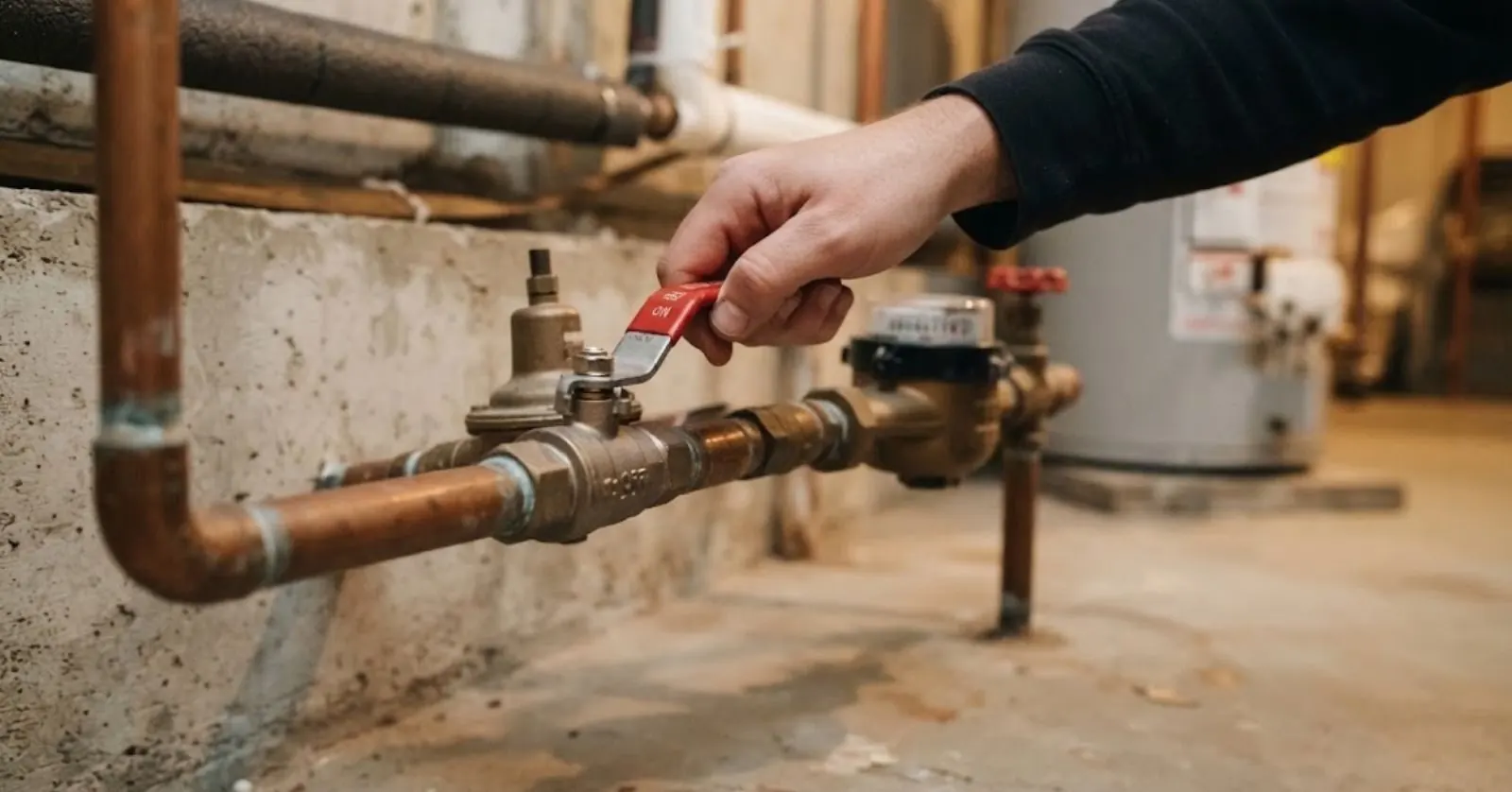
Where the main shutoff usually is
In most houses, the water line enters through the foundation wall or floor, and the shutoff is a few feet from that point. In a basement, look near the front foundation wall, close to the water meter, in a utility area or near the water heater. In a house on a slab, it may be in a closet, a garage or a mechanical room.
The line enters on the side of the house facing the street in most cases, so start there. If you have a well, the main shutoff is near the pressure tank, and the pump breaker is a second control you should know.
Types of main valves
Know which you have, because each works differently.
| Valve type | How it looks | How to close it | Note |
|---|---|---|---|
| Gate valve | Round wheel handle | Turn clockwise several times | Old ones stick and break if forced |
| Ball valve | Lever handle | Turn the lever a quarter turn, across the pipe | Fast and reliable |
| Stop and waste | Small valve with a drain cap | Turn clockwise, open the drain to empty the line | Common near the meter |
| Curb stop | In a box at the street | Needs a special key | Belongs to the utility |
| Meter valve | Next to the meter | Turn as with a ball or gate valve | Some are the utility's |
Take ten minutes now to find and test your shutoff. If you cannot close it during a leak, call us at once.
Call (860) 397-8103How to test your shutoff
Find the valve
Look at the pipe where the water enters and find the first valve after the meter. Tag it with a bright label so anyone in the house can find it.
Open a faucet
Run a tap at the lowest point in the house so you can see the water stop.
Close the valve slowly
Turn it all the way. A gate valve may take several turns. Do not force it if it resists.
Check the tap
The flow should slow and stop within a short time. A drip for a few seconds is normal, and a steady stream means the valve is not sealing.
Reopen and note the result
Open it again, and run a tap to clear air. Write down whether it closed fully and how many turns it took.
If the valve is stuck or leaks
A valve that has not moved in years can seize. Do not use a wrench to force a gate valve, because the stem can snap and the valve can fail in the open position. A valve that leaks when turned can be tightened at the packing nut a small amount, but one that drips constantly needs replacement.
If you cannot close the valve during a leak, the next valve is at the street, in a curb box, and it needs a key. Call your water supplier, and call a plumber at the same time. We can also replace an old gate valve with a quarter-turn ball valve, so it closes in a second.
Other shutoffs worth finding today
A leak at one fixture does not need the whole house off.
- <strong>Fixture stops.</strong> Small valves under sinks and behind toilets close water to one fixture.
- <strong>Water heater valve.</strong> A cold supply valve on top of the tank isolates it.
- <strong>Washing machine valves.</strong> Hot and cold valves behind the washer.
- <strong>Outdoor spigot valve.</strong> An inside valve to shut off and drain outdoor lines.
- <strong>Irrigation valve.</strong> A separate shutoff for a sprinkler system.
What to do in a leak, step by step
If water is escaping, close the main valve first. Then open the lowest faucet to drain the lines, which lowers pressure and slows the leak. Move belongings away from the water, and switch off power to wet areas only if you can reach the panel on dry ground.
Then call a plumber. Tell us where the water is, whether the valve closed and what you see. A burst pipe repair visit stops the leak and replaces the failed section, and a leak detection visit finds one you cannot see.
Teach everyone in the house
A shutoff is only useful if someone can reach it. Show every adult and older child where it is and how it turns. Keep a flashlight near it, and keep the area around it clear. If you rent the house, ask the landlord to show you and tag the valve.
If you travel often or have a vacation home, consider shutting off the main when you leave, especially in winter. Leave the heat on, drain the lines if the house will be empty for long and have someone check on it.
When to replace an old shutoff valve
Replace a valve that will not close fully, weeps at the stem or has a corroded body. Replacement is also wise before a remodel, because a good shutoff lets the plumber work without calling the utility. A new quarter-turn ball valve closes quickly, and you can see at a glance whether it is open or closed.
A quick family drill
Practice once. Pick a time when everyone is home, and have each person find the valve and close it while another person watches a faucet. Time how long it takes. A drill like this turns a panic into a routine, and it exposes a stuck valve before a leak does.
Take a photo of the valve with its label, and keep it in your phone. Write the supplier's phone number on a card beside it, and add our number, (860) 397-8103, for a plumbing emergency. Keep the card where a guest or a house sitter will see it too.
Code background on shutoff valves
Shutoff valves are required equipment under the 2021 International Plumbing Code (IPC), which the 2022 Connecticut State Building Code adopts, and replacing a failed main valve is licensed plumbing work. Whether a permit is needed depends on the job and the town, and the Enfield building department can confirm it.
The valve at the street and your supplier in Enfield
PURA's list of Connecticut water utilities shows Connecticut Water and Hazardville Water serving Enfield. Your bill shows which one serves your address, and that supplier owns the meter and the curb valve. Do not operate the curb valve yourself, and ask your supplier where its responsibility ends at your property.
Digging to repair a line requires notice to Call Before You Dig at 811 at least two full business days before mechanized digging. We help homeowners in Enfield and in nearby Windsor Locks and Suffield find and replace old shutoffs.
Main shutoff questions
Usually in the basement near the front foundation wall, close to the meter. In a slab house it may be in a closet or garage.
Often yes. Old gate valves can stick or break, and a ball valve closes in a quarter turn.
Call your water supplier and a plumber. The curb valve at the street needs a special key and belongs to the utility.
It is the supplier's valve and needs a key. Ask the supplier before you touch it.
Once a year is enough. It keeps the valve from seizing and tells you it works.